What's Trending: October 2026
What collectors scanned in October: a Pokémon-heavy month, 769 scans, the first estimated 10 in these reports, and why one shiny Jordan card came back 10, 8 and 7 in the same hour.
October brought 769 completed scans, more than three times September’s 245, and Pokémon was the biggest group by a wide margin. It also produced something the August and September reports didn’t have: an estimated 10.
Before you get excited about that, read the section on it below. One 10 out of 769 is a story about shiny cards more than it is a story about the tool suddenly finding perfect cards everywhere.
Last month’s report is here if you want to compare.
What People Are Scanning
Roughly 6 in 10 scans were trading card game cards, almost all of them Pokémon, with a few One Piece, League of Legends and Naruto cards mixed in. In September Pokémon sat around 16%, so this is a big jump.
It didn’t come evenly across the month, either. October 22 through 28 produced 320 scans, about 42% of everything for the month, and roughly 4 in 5 of those were trading card game cards, nearly all Pokémon. October 23 alone was 82 scans, 75 of them trading card game cards. A pattern like that usually means one source sending a bunch of people at once, but these numbers don’t show where they came from, so I’m not going to guess.
Of the sports cards, hockey and baseball were each around 11% of the month, basketball about 9%, soccer around 4%. The rest was a long tail. Football barely registered, though our name-based tagging misses a lot of older cards, so that one is probably undercounted. The vintage Batman and DC wave from September mostly faded: about 20 scans in October against 52 last month. The Batman cards among them averaged an estimated 5.6.
Which Cards Got the Most Scans?
Charizard, by a lot. Base Set Charizard shows up under so many slightly different names in the data (Holo, Holo Rare, Unlimited, Spanish, Italian) that it takes some adding up, but it comes to more than 20 scans of that one card. Most of them came back a 7, usually with a 6-8 range.
That’s the kind of result you’d expect from a 1999 holo. Spend five minutes looking through completed eBay sales for raw Base Set Charizards and you’ll see how few of them are clean. Whitening on the back edges and wear on the holo are the starting point, not the exception. Compare that with the modern Mew ex cards, which came back an estimated 9 on 16 of 26 scans. Same hobby, very different baseline.
The 1st Edition Base Set Pikachu had 7 scans on its own. On the sports side, Michael Jordan was the most-scanned player with 35 scans across Fleer, Skybox, Upper Deck and Flair cards from the mid-80s through the 90s, and those averaged about a 7. Lamine Yamal had 17 scans, mostly Panini LaLiga stickers and Adrenalyn cards, and averaged an 8 and change.
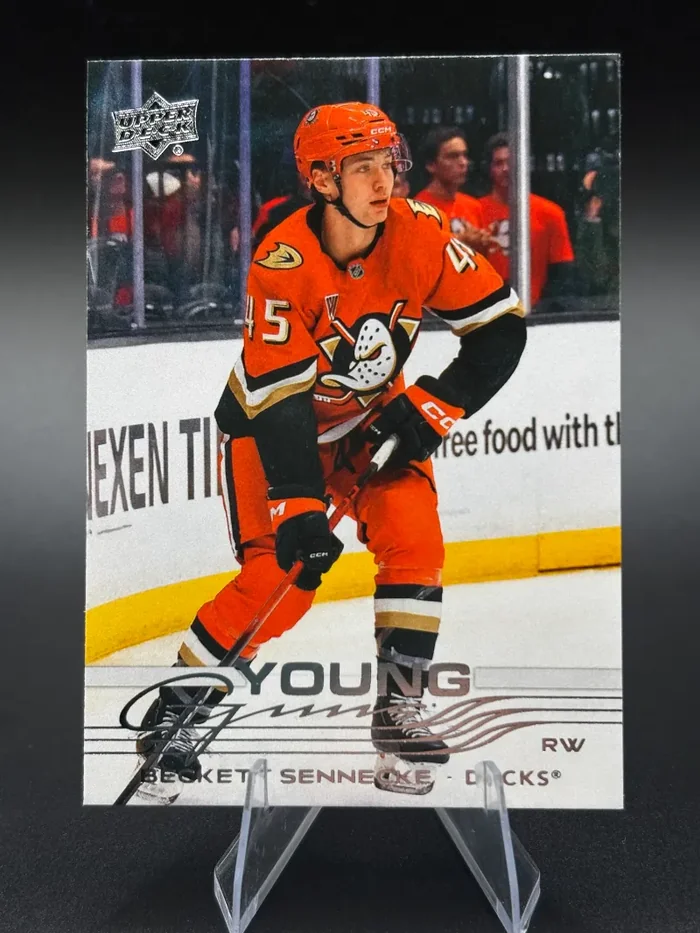
Last month’s most-scanned card made a return, too. Beckett Sennecke’s Young Guns was scanned four times in October (three of the #701 and one of the UD Canvas version) and came back an estimated 9 every time, with ranges of 8-9 or 8-10. That’s the same result as September, which is a good sign the read holds steady for a clean modern card.
How the Grades Landed
| Estimated grade | August | September | October |
|---|---|---|---|
| 10 | none | none | under 1% (one scan) |
| 9 | ~48% | ~25% | ~36% |
| 8 | ~23% | ~22% | ~26% |
| 7 | ~15% | ~25% | ~26% |
| 6 | ~7% | ~11% | ~8% |
| 5 or lower | ~8% | ~18% | ~3% |
That’s a recovery from September, and the reason is mostly what people scanned. September’s average got dragged down by a stack of 60-year-old Batman cards. October had far fewer of those and a lot more modern Pokémon, which tends to grade higher on a photo.
Grade 8-10 was the most common range, on about 29% of scans, followed by 7-9 and 6-8 at roughly 27% and 26%. Put those together and about 4 in 5 scans landed in one of those three ranges. A range that includes 10 on nearly 3 in 10 scans tells you more about where cards actually sit than a single number does.
The First Estimated 10
On October 31, a 1997-98 Fleer Metal Universe Michael Jordan #23 came back a 10, with 10s across centering, corners, edges and surface. That’s the first estimated 10 in these monthly reports.
Here’s what I’d want you to notice. In the same hour that day, three scans of what looks like that same Metal Universe Jordan came back a 10, an 8 and a 7. I can’t confirm it was the same physical card or the same person, but the names match and the timing is hard to ignore. Earlier in the month, a Skybox Metal Universe Jordan #23 was scanned three times and came back a 7 all three times.
Metal Universe is a card that fights the camera. It’s shiny, it’s busy, and a scratch or a print line can disappear in a reflection depending on how the light falls. Anyone who has tried photographing foil or chrome cards knows how much the result depends on the angle. So treat that 10 as a good photo of a shiny card, not as proof the card would come back a 10 from a grading company. If you want the background on why 10s are so hard to come by, the CGC results post goes through it.
That’s worth its own post, and I’ll get to it.
Two Pokémon Moments
Someone scanned a bootleg Charizard that the tool labeled as a counterfeit and gave a 1. A second Base Set Charizard came back labeled “authenticity disputed” with a 4. CrackorKeep isn’t an authenticator and I wouldn’t use it as one, but it’s good to see it speak up when a card looks wrong.
The less flattering part is card identification. The Scarlet & Violet 151 Mew ex Special Illustration Rare came back under two different card numbers (#152/128 and #158/165), so at least one of them was wrong. If you’re using the tool to identify an unfamiliar Pokémon card, check the number against the card itself before you trust it.
Average Condition Scores
Averaged across every scan with subgrades:
- Centering: 8.1 (September: 7.9)
- Corners: 7.8 (September: 7.2)
- Edges: 7.6 (September: 7.2)
- Surface: 7.6 (September: 7.1)
All four rose, and corners moved the most. Centering was the best score again, and edges and surface sat lowest, tied at 7.6. Surface is still the hardest of the four to judge from a photo.
Money Math
About 90% of scans were eligible for the Money Math calculator, up from about 77% in September and in line with August’s 88%. Eligibility has tracked the grade mix all three months. Lower-grade months, lower eligibility.
What I’d Take From This
Two things. First, if you’re going to scan a foil, chrome or refractor card, scan it more than once from a slightly different angle and look at the spread. If you get a 7, an 8 and a 10, the honest answer is somewhere in the middle, and the range on the result is a better guide than any single number.
Second, Pokémon collectors are showing up in real numbers now. If that’s you, the cards that grade best on a photo are the clean modern ones, and the 1999 holos tend to land in the 6-8 range, which is a useful number to have before you spend money on grading.
If you’ve got something odd in your own box, run it through CrackorKeep . It might show up in the November report.
About the data: This report covers completed CrackorKeep card analyses from October 1 through October 31, 2026, 769 in total. Two analyses that returned no grade were left out of the percentages. Failed or incomplete analyses were excluded. Repeat scans of the same card are included, and our own test scans, if any, were not filtered out. Category splits are inferred from card names, so treat them as approximate. All grades are AI-generated pre-grading estimates, not professional grading results.
Grade Your Card Before You Pay PSA
Upload your card photos and get an instant AI estimate across centering, corners, edges, and surface. No account. No credit card. Just an honest grade.
Check This Raw Card →